| |
 |
Problems and Solutions
Problems
- Extraction of timber from the forest, albeit at a much lower rate still continues, leading to further environmental destruction. The main use of timber is for firewood as for most people there are no alternative means of cooking. In the towns there is a ready market for charcoal and there is evidence of illegal charcoal burning in the forest around Mt. Kenya. Wood is also a major construction material.
- With 75% of Kenya’s population involved in agriculture, rainfall has always been important, but it is unpredictable. The length and amount of precipitation that can fall during the rainy season varies greatly. Farmers have long adapted to this, but with increasing climate change droughts are becoming more frequent and last longer. Extremely heavy rain at the wrong time can wash away seeds and young plants.
- As the local population continues to rise, farming becomes more intensive increasing the occurrence of soil erosion.
Solutions
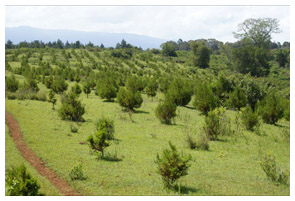
- The cultivation and free distribution of fast-growing trees is helping to reduce dependence on the forest for firewood. The project encourages recipients to plant these trees and within a few years will have eliminated the need to deplete remaining forest resources.
- Varieties such as Mexican Ash are popular for construction timber. By growing such plants, local farmers can produce their own fencing and building wood without using indigenous forest species.
- By planting the fast-growing trees along farm boundaries, hedging can be provided to keep straying animals away from crops as well as aiding soil stability.
- Soil erosion can be a problem on exposed slopes especially during the rainy season. In order alleviate this, farmers need encouragement to plant trees across slopes and along stream banks. As they develop, the roots will stabilise the soil.
- Cooking is normally carried out over a traditional three-stone wood fire which wastes a lot of the generated heat. One method of improving this and at the same time reducing the amount of wood is by encouraging the introduction of brick ovens. At present this is at the experimental stage.
- For all the above to be effective, education of the farmers is essential. Not only can this be done through example and by talking to the local community, it is vital to involve children. In this way the members of the tree project are encouraged to support the Nursery School and provide advice to the Primary School for their school garden.
|
|
|
|
|
|
| |
|
|
|
|