| |
 |
The Vital Role of Forests
-
Forests play a vital role in helping sustain life on Earth. However, over the past fifty years about half the world’s forest cover has disappeared. Worldwide, over 1.6 billion people depend directly on forests for food, clothing, shelter and medicines.
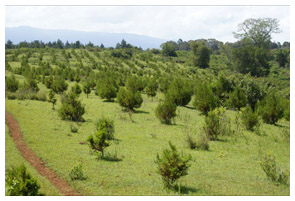
Mt. Kenya is no different. Its forests contain some 284 plant species and are home to a wide range of birds, mammals and insects. The timber is vital to the local economy, providing both firewood and construction timber.
- Forests clean the atmosphere by absorbing pollutants such as nitrous oxides, sulphur dioxide and carbon monoxide. As such they are essential worldwide.
- Forests store vast amounts of carbon dioxide. Through your donations to the Mt. Kenya Tree Nursery you are helping to reduce your carbon footprint.
- Through photosynthesis oxygen is produced.
- The leaves and branches, not only produce shade but they reduce the impact of falling rain on the ground, allowing the water to be more readily absorbed. The ground then acts as a sponge, retaining water during the rainy season and steadily releasing it in the dry season.
- If the tree cover is removed the full force of the tropical rain hits the ground, compacting the soil and preventing most of the water from filtering into the ground. Much of the rainwater then flows rapidly away over the soil and into the rivers. This results in an increased likelihood of drought during the dry season.
- Tree roots help hold the top soil together, especially on mountain slopes. Their removal thus creates soil erosion and the loss of fertile top soil.
- The atmosphere within a forest is humid. This in turn increases the humidity of the air above, aiding the creation of clouds and eventually rainfall. A consequence of de-forestation is a decrease in humidity, less cloud cover and eventually less rain.
- Mt. Kenya is a vital water catchment area for the nation. Its streams not only feed two major rivers, but seven million people depend directly on the water for farming. Most of Kenya’s hydro-electricity is generated from water that falls on the slopes of the mountain. A serious drop in water flow would severely affect the country’s economy.
It is now recognised that de-forestation on the slopes of Mt. Kenya contributed towards the severe drought in 2009.
- Forests are home to a wide range of animals, birds and insects. Mt. Kenya supports the rare Abbot’s Starling as well as threatened mammals such as the Leopard, Giant Forest Hog, Bongo, Black-fronted Duiker and Elephant. Many elephant migrate from as far away as the Samburu to browse in the forest.
Whilst the planting of non-indigenous trees is not contributing directly to replacing the region’s lost biodiversity, it does help significantly in preserving what remains by providing an alternative source of timber.
|
|
|
|
|
|
| |
|
|
|
|