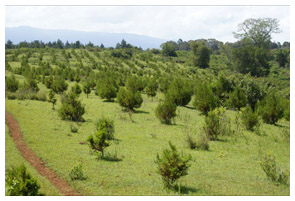
Types of Trees
Many types of trees are cultivated in the Tree Nursery, suiting the environment and the needs of local inhabitants.
Casuarina cunninghamiana
Introduced into Africa from Australia, it is a moderately fast-growing evergreen that grows up to 35 metres in height. Not only does it tolerate drought but also waterlogging and can grow in poor soils. Its roots contain nitrogen fixing bacteria.
The casuarina is a popular tree as it has many uses. It can be grown to form a wind break and harvested for building poles, as well as firewood. The leaves can be used animal fodder, whilst the roots will stabilise soil erosion.
Cupressus lusitanica
Introduced into Kenya in 1910, this is a popular plantation tree that grows up to 35 metres in height. Fast-growing and having distinctive blue-green evergreen leaves, it prefers reasonable amounts of rainfall but will tolerate seasonal drought.
Widely known as Mexican Cypress it is used for furniture, construction, fence posts and firewood. It also makes a good hedging plant.
Grevillea robusta
This is another tree that was introduced into Africa from Australia, being semi-deciduous, very fast-growing, whilst withstanding seasonal drought and poor soils. It is very useful in reclaiming disturbed land as its fallen leaves produce large quantities of leaf litter.
Whilst the flowers are a favourite with bees, the timber is tough and is used for quality furniture, plywood, fence posts and firewood. It also serves well as a shade plant on farms.
Fraxinus pennsylvanica
As its name suggests this species has been introduced from North America and is also called Mexican or Green Ash. It is a hardy tree, growing best in situations between 1,500 and 2,000 metres above sea level. It prefers moist soil and so is ideal for growing alongside streams.
Growing to 15 metres, it is very good as a windbreak, whilst its timber is useful for construction, fence posts and as firewood. The leaves can also be used as cattle fodder.
Introduced species have been favoured so far as they grow quickly and so produce rapid results. More recently a number of indigenous species have begun to be cultivated. Although slow growing, a big advantage is that their seeds can be collected from the wild.
Olea Africana
This tree, native to East Africa is found from the Red Sea up into wet mountainous regions, tolerating temperatures that vary from -5 degrees C. to 40 degrees C. It is slow growing, drought tolerant and makes a good shade tree. The fruit is a favourite with birds whilst the flowers attract bees. The hard timber is ideal for making quality furniture, woodcarvings, poles and flooring.
Podocarpus falcatus
This is an evergreen tree found in upland forests between 1,500 and 2,400 metres above sea level. It can grow to 35 metres in height and the fruit is a favourite of both birds and monkeys, both of which provide an important role in seed dispersal, by releasing the seeds from the fruit.
Podocarpus wood does not weather well and so is not best used for exterior work. However it is ideal for fuel, furniture, panelling and poles.
Ficus ariocarpa
Also known as the Strangler Fig, this hardy plant can be found in environments that range from open grassland to upland rainforest up to 2,500 metres above sea level. It can be epiphytic (growing on another tree), producing both buttress and aerial roots. Its leaves make useful green manure as well as fodder.